20. Space Mission Planning
Archived No proven speedupQAOA on a four-leg toy mission QUBO with no proven speedup; not a trajectory optimizer. Classical trajectory optimizers mature. Archived per Troyer framework.
Run Visualisation
Rendered from the committed estimate and simulator artifacts by the viz pipeline.
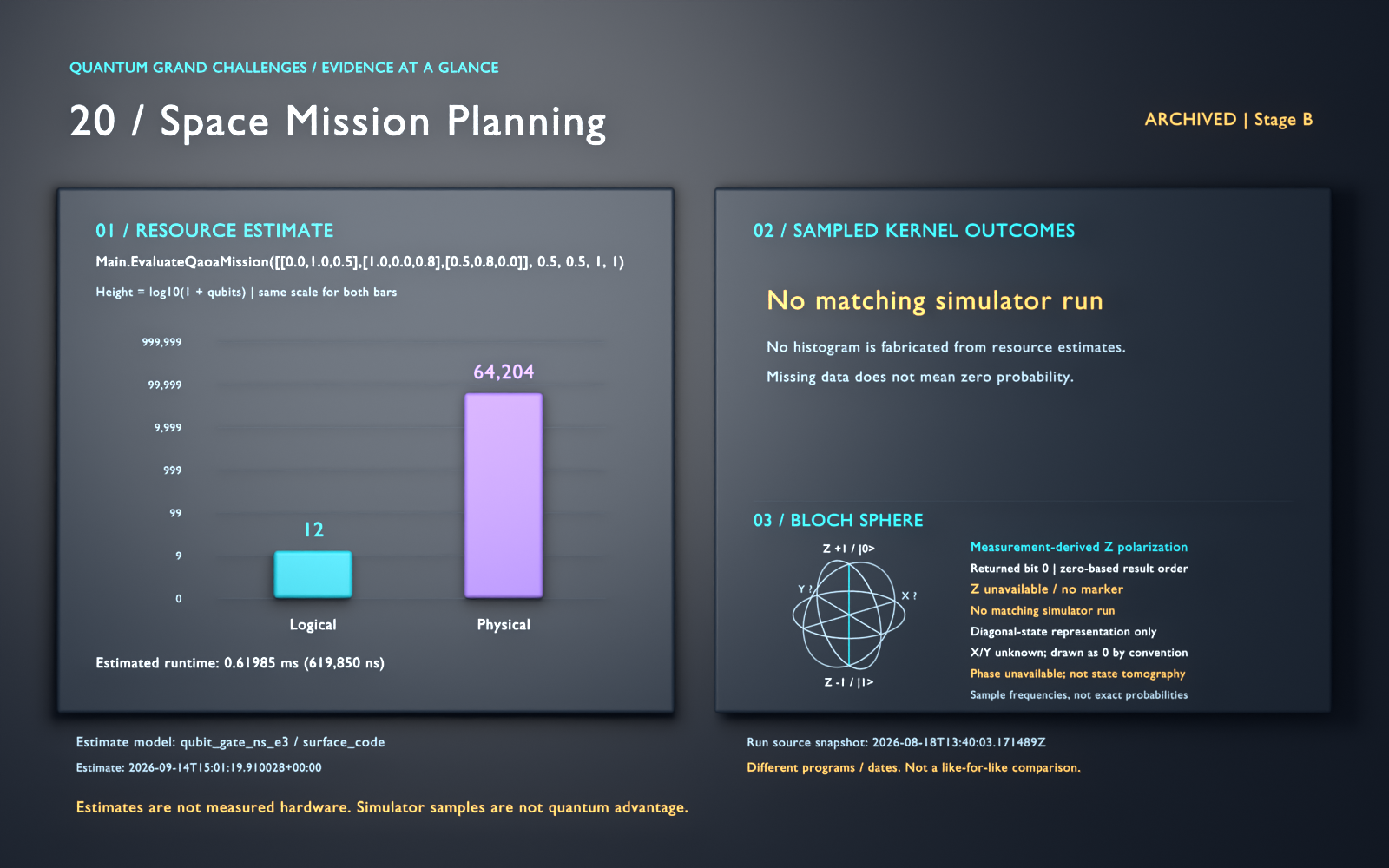
- Resource estimates and sampled kernel outcomes describe different programs. Neither demonstrates quantum advantage; this is not a quantum-state animation.
- No successful local-simulator histogram in the selected run source.
- Archived problem; not an active quantum-advantage candidate.
- This poster was rendered from an earlier estimate (12 logical, 64,204 physical qubits for Main.EvaluateQaoaMission([[0.0,1.0,0.5],[1.0,0.0,0.8],[0.5,0.8,0.0]], 0.5, 0.5, 1, 1)). The kernel or the estimated program changed on 2026-09-26; the current estimate is 15 logical, 70,255 physical qubits for Main.EvaluateQaoaMission([[2.5,1.8],[1.2,0.8],[3.1,2.4],[1.5,1.0]], 0.667588438887831, 1.3940817400304706, 1, 1).
Resource Estimation (Azure Quantum RE)
Resource Breakdown
Calibration Evidence (20-Run Ensemble)
Noise Resilience (Depolarizing Simulation)
Ideal outcome: [Zero, One, One, Zero] (14% probability)
Cross-Platform Emulator Results (100 shots)
This run was recorded in April 2026 against a hardware kernel that implemented a different model, aligned on 2026-09-26. The shot distribution below is a real measurement, but it is a measurement of a program that no longer exists in this repository, and it has not been re-run against the current kernel.
Troyer Utility-Scale Classification
Trajectory optimization is well-served by classical methods. QAOA for routing/scheduling has the same unproven-advantage limitations as other combinatorial optimization problems. This kernel is a four-leg toy QUBO, not a trajectory optimizer.
These two numbers describe different programs
The resource estimate below is for Main.EvaluateQaoaMission([[2.5,1.8],[1.2,0.8],[3.1,2.4],[1.5,1.0]], 0.667588438887831, 1.3940817400304706, 1, 1), the algorithm at utility scale. The Azure Quantum runs executed MissionQaoaKernel(), a small kernel sized to fit today's hardware. Qubit counts and runtimes from the estimate are not measurements of the run, and the run histogram is not a sample of the estimated circuit.
Pareto Frontier: Qubits vs Runtime
The estimator returns 10 viable configurations, not one answer. Every headline figure on this page comes from the leftmost point, which uses the fewest qubits and is therefore also the slowest. Buying 4.3x the qubits cuts runtime to 0.36x.
qubit_gate_ns_e3 with surface_code, error budget 1e-3. Points are Pareto-optimal: no other configuration is better on both axes.
Multi-Model Resource Comparison
Physical qubit requirements across 6 qubit technologies × 2 QEC schemes (inspired by Troyer Architecture Series, Part 3).
| Qubit Model | QEC | Physical Qubits | Logical Qubits |
|---|---|---|---|
| Superconducting (ns, 1e-4) | surface_code | 13,875 | 15 |
| Trapped Ion (μs, 1e-4) | surface_code | 13,875 | 15 |
| Superconducting (ns, 1e-3) | surface_code | 70,255 | 15 |
| Trapped Ion (μs, 1e-3) | surface_code | 70,255 | 15 |
Problem Documentation
Problem 20 · Toy QAOA Mission-Planning QUBO
Overview
This archived problem contains a heuristic mission-scoring script and a separate Q# depth-1 QAOA toy QUBO. The Q# model chooses one of two options for each of four mission legs and adds a pairwise penalty when two legs choose the same option. It is not a patched-conic trajectory optimizer.
Correction (2026-09-26): Earlier text blurred the classical patched-conic scoring script with the Q# model, and the hardware kernel used a different three-qubit chain with different biases. The hardware kernel now matches the four-leg model in Main.RunMissionOptimization and uses optimized p=1 angles. Existing website emulator results predate this alignment and should be labelled as stale until regenerated.
Verified toy model
- Q# source: `qsharp/src/Main.qs`.
- Hardware kernel: `qsharp/HardwareKernel.qs`.
- Cost function: four option costs `[[2.5, 1.8], [1.2, 0.8], [3.1, 2.4], [1.5, 1.0]]` plus `0.5` for each equal-option pair.
- Exact brute-force optimum of the toy QUBO: `7.9`.
- Exact state-vector expectation at the optimized p=1 angles `gamma=0.667588438887831`, `beta=1.3940817400304706`: `8.567469059209166`.
- Approximation ratio for this minimization toy objective: `1.0845`.
- There is no proven QAOA speedup claimed for this problem.
Classical baseline
python/classical_baseline.py implements heuristic patched-conic scoring for YAML mission records. It estimates aggregate delta-v, slack, feasibility, and a mission score. It is not the same objective as the Q# toy QUBO.
Directory Layout
20_space_mission_planning/
├── ARCHIVED.md
├── README.md
├── estimates/
├── instances/
├── plots/
├── python/
│   ├── analyze.py
│   ├── classical_baseline.py
│   └── test_baseline.py
└── qsharp/
    ├── HardwareKernel.qs
    ├── qsharp.json
    └── src/
        └── Main.qs
Quick Start
cd problems\archived\20_space_mission_planning
python python\classical_baseline.py
python python\analyze.py
python -c "from qdk import qsharp; qsharp.init(project_root='qsharp'); print(qsharp.run('Main.RunMissionOptimization()', 1))"
Objective Maturity Gate
- **Current gate**: **Stage B complete** for a toy QUBO scaffold only.
- **Next gate target**: none scheduled. Any future mission-planning claim must compare the same objective on both classical and quantum sides.
DiVincenzo Readiness (Stage C/D Overlay)
| Criterion | Status | Evidence / Notes |
|---|---|---|
| Scalable qubit system | partial | Four toy QUBO variables are implemented; no realistic trajectory encoding exists. |
| Initialization | partial | Uniform-superposition QAOA initialization is implemented for the toy model. |
| Coherence vs gate time | not-yet | Backend-calibrated coherence-vs-depth evidence is not current after kernel alignment. |
| Universal gate set | partial | The Q# and QASM circuits use standard one- and two-qubit gates. |
| Qubit-specific measurement | partial | Computational-basis measurement is implemented; hardware readout characterization is stale. |
Advantage Claim Contract
- **Claim category (current)**: `theoretical`.
- **Fair baseline**: heuristic patched-conic scoring for YAML records, plus exact enumeration for the four-bit Q# toy model in tests.
- **Residual risks**: the classical heuristic and Q# toy objective are different models, and shared website emulator records are stale until regenerated.
Reproduce It
cd problems/20_space_mission_planning
make classical        # Run classical baseline
make analyze          # Generate plots
make build            # Validate Q# compilation
make run              # Run Q# entry point
Key Files
qsharp/src/Main.qsQuantum algorithm implementationqsharp/HardwareKernel.qsAzure-submittable QIR kernelpython/classical_baseline.pyClassical reference implementationestimates/classical_baseline.jsonBaseline metrics