19. Quantum Chromodynamics
Stage C - CalibratedTrotterized transverse-field Ising chain, a spin-chain stand-in for lattice gauge dynamics (no gauge fields yet). 20-run ensemble: Z-parity 0.46 ± 0.05 (95% CI; exact 0.487). 55k physical qubits, 9 logical.
Run Visualisation
Rendered from the committed estimate and simulator artifacts by the viz pipeline.
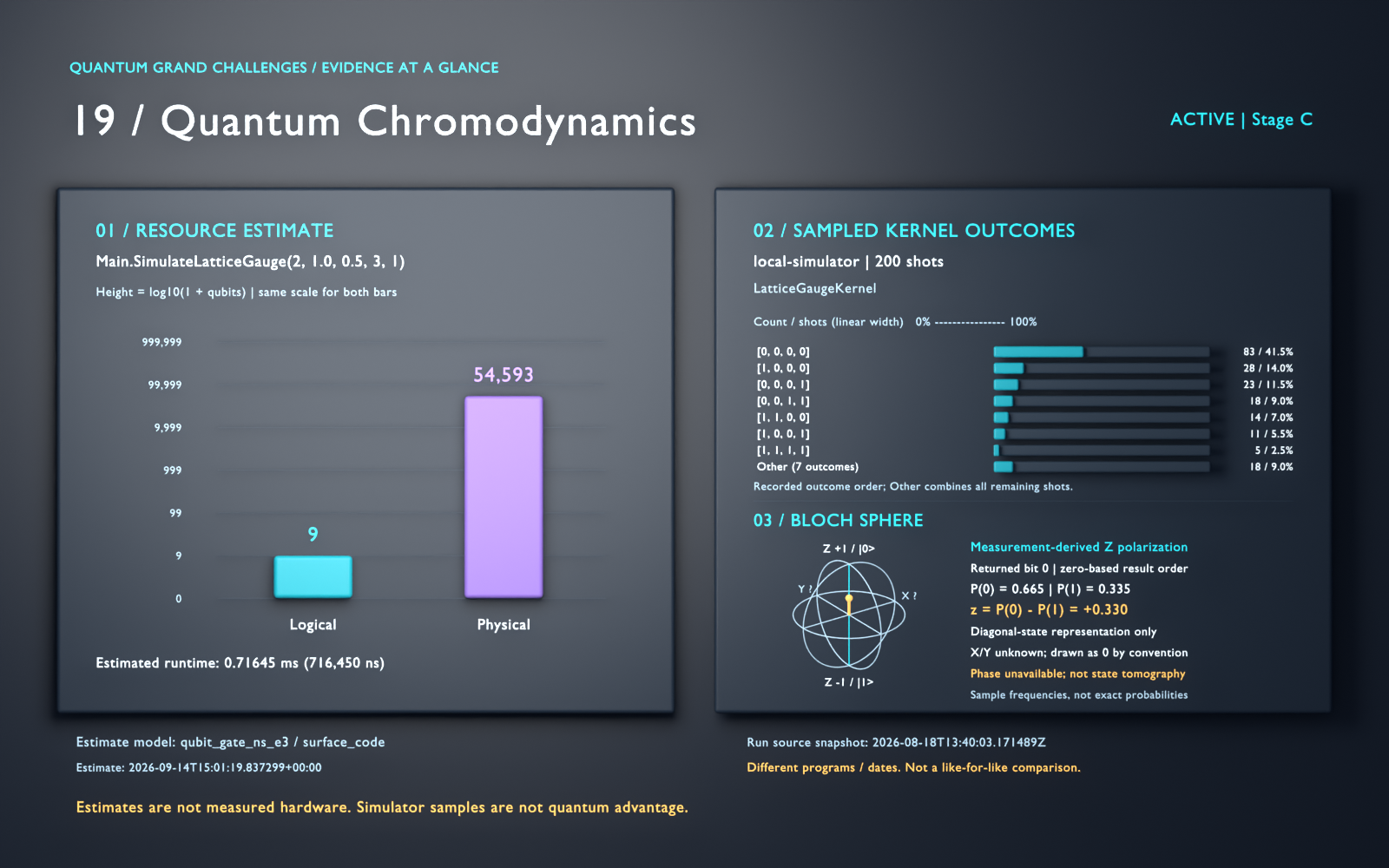
- Resource estimates and sampled kernel outcomes describe different programs. Neither demonstrates quantum advantage; this is not a quantum-state animation.
Resource Estimation (Azure Quantum RE)
Resource Breakdown
Calibration Evidence (20-Run Ensemble)
Noise Resilience (Depolarizing Simulation)
Ideal outcome: [Zero, Zero, Zero, Zero] (46% probability)
Cross-Platform Emulator Results (100 shots)
Troyer Utility-Scale Classification
Lattice gauge theory is arguably the strongest utility candidate. Classical lattice QCD cannot simulate real-time dynamics due to the sign problem. Quantum simulation of gauge theories could enable predictions impossible classically, but realistic lattice sizes need large fault-tolerant machines (Kan and Nam, arXiv:2107.12769, give the gate costs). This project's kernel is not yet such a simulation: it evolves a transverse-field Ising chain, which has no gauge fields and maps to free fermions.
These two numbers describe different programs
The resource estimate below is for Main.SimulateLatticeGauge(2, 1.0, 0.5, 3, 1), the algorithm at utility scale. The Azure Quantum runs executed LatticeGaugeKernel(), a small kernel sized to fit today's hardware. Qubit counts and runtimes from the estimate are not measurements of the run, and the run histogram is not a sample of the estimated circuit.
Pareto Frontier: Qubits vs Runtime
The estimator returns 9 viable configurations, not one answer. Every headline figure on this page comes from the leftmost point, which uses the fewest qubits and is therefore also the slowest. Buying 2.4x the qubits cuts runtime to 0.39x.
qubit_gate_ns_e3 with surface_code, error budget 1e-3. Points are Pareto-optimal: no other configuration is better on both axes.
Multi-Model Resource Comparison
Physical qubit requirements across 6 qubit technologies × 2 QEC schemes (inspired by Troyer Architecture Series, Part 3).
| Qubit Model | QEC | Physical Qubits | Logical Qubits |
|---|---|---|---|
| Superconducting (ns, 1e-4) | surface_code | 9,893 | 9 |
| Trapped Ion (μs, 1e-4) | surface_code | 9,893 | 9 |
| Superconducting (ns, 1e-3) | surface_code | 54,593 | 9 |
| Trapped Ion (μs, 1e-3) | surface_code | 54,593 | 9 |
Problem Documentation
Problem 19 · Quantum Chromodynamics
Overview
Nonperturbative quantum chromodynamics (QCD) remains one of the central frontiers in high-energy physics. This scaffold pairs a classical estimate of lattice gauge observables with a Q# kernel that stands in for the quantum simulation this problem is about.
What the code computes. The quantum kernel is Trotterized real-time evolution of a transverse-field Ising chain, H = beta sum Z_i Z_{i+1} + h sum X_i, from |0...0>, measuring the product of Z over all sites. It is not a gauge theory: there are no gauge fields and no Gauss's law, and the 1D transverse-field Ising chain maps to free fermions, so it is classically solvable at any size. Earlier versions of this page and the site called the measured quantity a Wilson loop and printed a confinement signature (area law at small beta, perimeter law at large beta); a single fixed-size string evolved for unit time from a product state cannot show either. tooling/test_ising_chain_kernel.py checks the program, the hardware kernel and the OpenQASM export against exact evolution of the same circuit. The classical baseline is a separate heuristic: closed-form formulas for SU(3) plaquette, string-tension and glueball-mass proxies, not a lattice Monte Carlo and not the model the quantum kernel simulates. A kernel that models gauge dynamics (Gauss's-law constraints, then plaquettes) is the first milestone below.
Directory Layout
19_quantum_chromodynamics/
├── estimates/                        # JSON artifacts from classical and quantum workflows
├── instances/                        # Lattice sizes, spacings, and coupling constants
├── plots/                            # Generated figures from analyze.py
├── python/
│   ├── classical_baseline.py         # Heuristic SU(3) plaquette, string-tension and glueball-mass proxies
│   └── analyze.py                    # Visualization of plaquette energy and string tension trends
└── qsharp/
    ├── qsharp.json                   # Modern QDK project file
    ├── HardwareKernel.qs             # 4-site Ising-chain Trotter kernel for Azure Quantum
    └── src/Main.qs                   # Trotterized transverse-field Ising chain (see Overview)
Quick Start
cd problems/19_quantum_chromodynamics

# Classical lattice baseline
python python/classical_baseline.py

# Plot plaquette energy and string tension behaviour
python python/analyze.py

# Quantum kernel (uses modern QDK  qsharp Python package)
python -c "from qdk import qsharp; qsharp.init(project_root='qsharp'); qsharp.run('Main.RunQCDSimulation()', 1)"
Next Quantum Milestones
1. Hamiltonian Encoding – Map Kogut-Susskind Hamiltonians onto qubit registers with flux truncation.
2. Gauge Constraints – Integrate Gauss law projectors for SU(3) or SU(2) toy models.
3. Spectral Estimation – Prototype adiabatic state preparation and phase estimation for glueball spectra.
4. Resource Estimation – Track qubit counts and trotterisation depth as lattice volume scales.
This scaffold keeps the lattice baseline reproducible while setting up future quantum simulations of the strong force.
Objective Maturity Gate
- **Current gate**: **Stage C complete** (hardware-aware validation evidence in place: Trotterized Ising-chain kernel runnable, calibration ensemble across runs, backend assumptions documented, dual-model estimator profile, OpenQASM export, Azure smoke validation).
- **Next gate target**: **Stage D** (advantage evidence package: fairness review against Euclidean lattice QCD for static observables, residual risks for real-time dynamics / sign problem, claim category locked). A Stage D claim would first need a kernel that models gauge dynamics: the current Ising chain is classically solvable at any size.
Stage C evidence references for this problem:
- Calibration ensemble: `estimates/quantum_calibration_ensemble.json` (the mean Z-parity of a 2-site chain, previously labelled a Wilson loop) and `estimates/calibration_evidence.json`.
- Backend assumptions: `estimates/backend_assumptions.md`.
- Estimator profile (ns-e3 + surface-code-generic): `estimates/estimator_profile_summary.md`, `estimates/latest_qubit_gate_ns_e3.json`, `estimates/latest_surface_code_generic_v1.json`.
- Cross-platform OpenQASM export: `estimates/trotter_gauge.qasm`, the same circuit as `qsharp/HardwareKernel.qs` since 2026-09-26 (it previously used angles too small to distinguish a right circuit from a wrong one).
- Azure smoke validation: `estimates/azure_smoke_report_small_d1.md`, `estimates/azure_job_manifest_small_d1.json`.
DiVincenzo Readiness (Stage C/D Overlay)
| Criterion | Status | Evidence / Notes |
|---|---|---|
| Scalable qubit system | partial | Problem-scoped instance baselines are in place; full hardware-scale projections are tracked as Stage C work. |
| Initialization | partial | Input/state initialization path is defined for current workflows, with backend-ready loading fidelity still to be hardened. |
| Coherence vs gate time | not-yet | Backend-calibrated coherence-vs-depth evidence is pending and required for Stage C/D promotion. |
| Universal gate set | partial | Q# scaffold/build path exists; gate-basis decomposition and transpilation evidence remain Stage C tasks. |
| Qubit-specific measurement | partial | Measurement outputs are defined for current validation flows; hardware readout characterization is pending. |
Advantage Claim Contract
- **Claim category (current)**: `theoretical`.
- **Problem class and regime**: Problem-specific challenge instances defined in this directory.
- **Fair baseline**: Problem-local classical baseline in `python/` outputs.
- **Quantum resource scaling claim**: Expected asymptotic advantage depends on algorithm family and implementation assumptions; no hardware-demonstrated speedup claim yet.
- **Data-loading and I/O assumptions**: Must be documented alongside future advantage claims.
- **Noise/error model assumptions**: Backend-specific model and calibration assumptions to be added at Stage C.
- **Confidence/uncertainty method**: To be reported using shot-based confidence intervals or equivalent statistical bounds.
- **Residual risks**: Oracle/state-preparation/transpilation overhead may dominate for near-term instance sizes.
Reproduce It
cd problems/19_quantum_chromodynamics
make classical        # Run classical baseline
make analyze          # Generate plots
make build            # Validate Q# compilation
make run              # Run Q# entry point
Key Files
qsharp/src/Main.qsQuantum algorithm implementationqsharp/HardwareKernel.qsAzure-submittable QIR kernelpython/classical_baseline.pyClassical reference implementationestimates/classical_baseline.jsonBaseline metrics