11. Quantum Machine Learning
Archived I/O limitedSwap-test kernel on amplitude-encoded classical data: loading costs O(d) gates and each kernel entry needs O(1/ε²) shots, so it has no speedup. Provable separations exist only for constructed datasets. Archived per Troyer framework.
Run Visualisation
Rendered from the committed estimate and simulator artifacts by the viz pipeline.
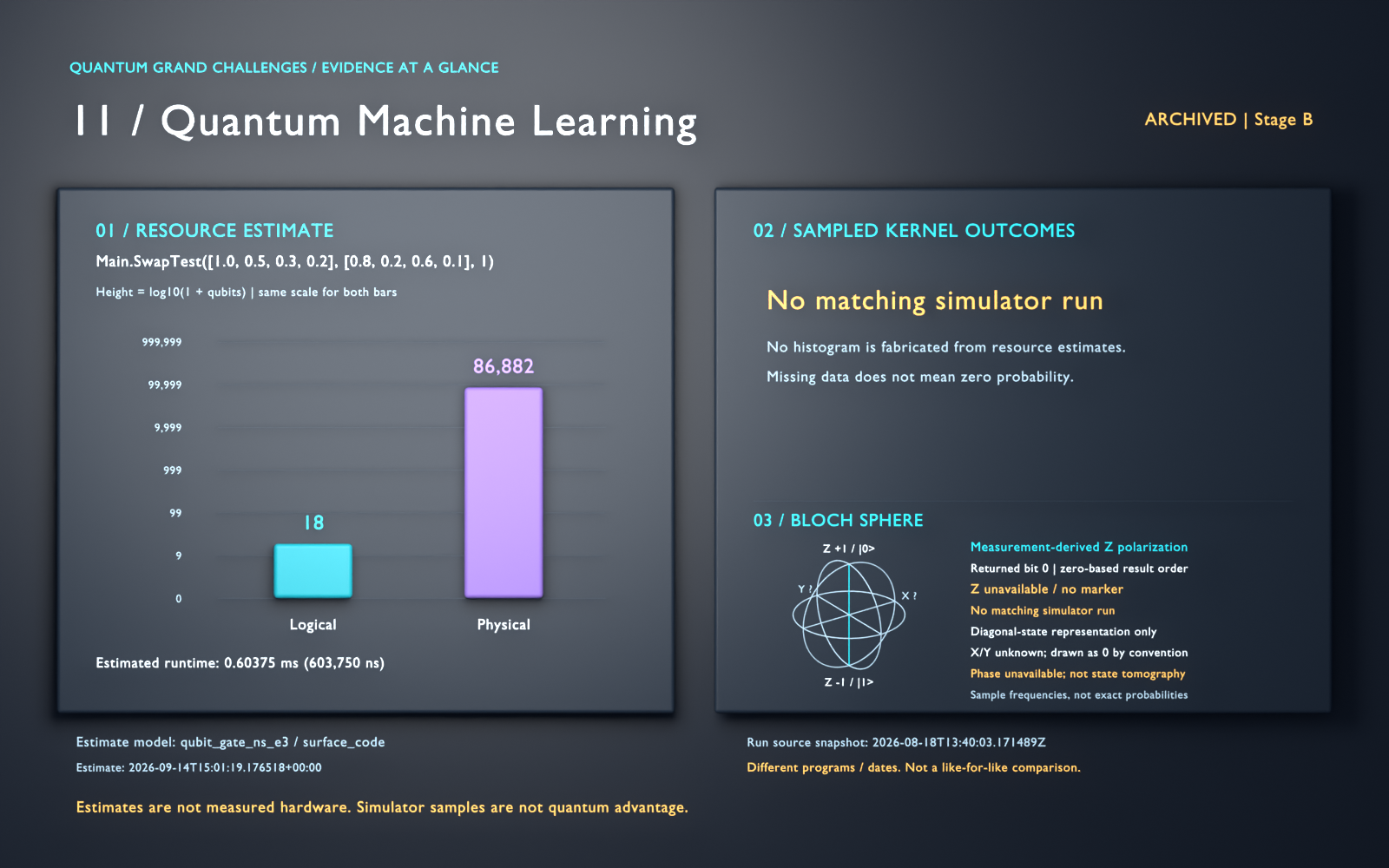
- Resource estimates and sampled kernel outcomes describe different programs. Neither demonstrates quantum advantage; this is not a quantum-state animation.
- No successful local-simulator histogram in the selected run source.
- Archived problem; not an active quantum-advantage candidate.
Resource Estimation (Azure Quantum RE)
Resource Breakdown
Calibration Evidence (20-Run Ensemble)
Noise Resilience (Depolarizing Simulation)
Ideal outcome: [Zero] (94% probability)
Cross-Platform Emulator Results (100 shots)
This run was recorded in April 2026 against a swap-test kernel that compared two unrelated product states, replaced on 2026-09-26. The shot distribution below is a real measurement, but it is a measurement of a program that no longer exists in this repository, and it has not been re-run against the current kernel.
Troyer Utility-Scale Classification
QML speedups depend on data encoding assumptions. If classical data must be loaded into quantum states, the loading cost often negates the kernel speedup; here loading a d-dimensional vector costs O(d) gates and each kernel entry needs O(1/ε²) shots. Proven advantages exist only for specific, contrived problem structures, such as the discrete-logarithm datasets of Liu, Arunachalam and Temme (Nat. Phys. 17, 1013, 2021, arXiv:2010.02174).
These two numbers describe different programs
The resource estimate below is for Main.SwapTest([1.0, 0.5, 0.3, 0.2], [0.8, 0.2, 0.6, 0.1], 1), the algorithm at utility scale. The Azure Quantum runs executed SwapTestKernel(), a small kernel sized to fit today's hardware. Qubit counts and runtimes from the estimate are not measurements of the run, and the run histogram is not a sample of the estimated circuit.
Pareto Frontier: Qubits vs Runtime
The estimator returns 11 viable configurations, not one answer. Every headline figure on this page comes from the leftmost point, which uses the fewest qubits and is therefore also the slowest. Buying 2.1x the qubits cuts runtime to 0.36x.
qubit_gate_ns_e3 with surface_code, error budget 1e-3. Points are Pareto-optimal: no other configuration is better on both axes.
Multi-Model Resource Comparison
Physical qubit requirements across 6 qubit technologies × 2 QEC schemes (inspired by Troyer Architecture Series, Part 3).
| Qubit Model | QEC | Physical Qubits | Logical Qubits |
|---|---|---|---|
| Superconducting (ns, 1e-4) | surface_code | 15,866 | 18 |
| Trapped Ion (μs, 1e-4) | surface_code | 15,866 | 18 |
| Superconducting (ns, 1e-3) | surface_code | 86,882 | 18 |
| Trapped Ion (μs, 1e-3) | surface_code | 86,882 | 18 |
Problem Documentation
Problem 11 · Quantum Machine Learning Kernel Benchmark
Overview
Quantum kernel methods map classical data into high-dimensional Hilbert spaces using parameterized feature maps. This directory holds two pieces that measure different things:
- **Q# swap test** (`qsharp/src/Main.qs`): amplitude-encodes 4-feature vectors on two qubits each and estimates |⟨a|b⟩|² from P(ancilla = 0) = (1 + |⟨a|b⟩|²)/2. The error falls as 1/√shots, so additive error ε costs O(1/ε²) repetitions, and loading a d-dimensional classical vector costs O(d) gates in general: for classical data the same kernel is computable classically in O(d) time, and this example demonstrates no speedup.
- **Classical baseline** (`python/classical_baseline.py`): kernel ridge classification with a radial-basis-function kernel on synthetic datasets. It reports classification accuracy, a different task from the Q# overlap estimate.
Correction (2026-09-26)
The encoding applied an absolute value to every amplitude, so vectors with negative entries were encoded as their absolute values while the classical reference kept the signs (for [0.5, −0.5, 0.5, 0.5] against [0.5, 0.5, 0.5, 0.5] the swap test returned P(0) = 1 instead of 0.625). The hardware kernel swapped two product states unrelated to any feature vector; it now encodes the estimator's vectors, with exact P(0) = 0.9175. The demo claimed the swap test needs O(1) measurements and gives an exponential speedup; both claims are removed. tooling/test_swap_test_kernel.py pins the encoding, the program and the hardware kernel to exact values.
Directory Layout
11_quantum_machine_learning/
├── estimates/                      # JSON artifacts from classical / quantum workflows
├── instances/                      # Dataset parameter sets (small/medium/large)
├── plots/                          # Generated figures from analyze.py
├── python/
│   ├── classical_baseline.py       # Kernel ridge classification baseline
│   └── analyze.py                  # Visualization of accuracy and alignment metrics
└── qsharp/
    ├── qsharp.json                 # Modern QDK project file
    ├── src/Main.qs                 # Swap-test kernel estimation
    └── HardwareKernel.qs           # QIR kernel for Azure Quantum
Quick Start
cd problems/archived/11_quantum_machine_learning

# Classical baseline (writes estimates/classical_baseline.json)
python python/classical_baseline.py

# Visualize accuracy and kernel statistics
python python/analyze.py

# Swap-test kernel demo
python -c "from qdk import qsharp; qsharp.init(project_root='qsharp'); qsharp.run('Main.RunQuantumKernelEstimation()', 1)"
Next Quantum Milestones
1. Feature Map Implementation – Encode classical feature vectors into amplitude or Hamiltonian embeddings within Q#.
2. Quantum Kernel Evaluation – Use swap-test style overlaps to assemble Gram matrices for downstream classifiers.
3. Hybrid Training Loop – Combine quantum kernel evaluations with classical optimizers for model selection.
4. Resource Estimation – Evaluate qubit counts and circuit depth for realistic dataset sizes and compare against classical baselines.
This scaffold keeps the classical kernel baseline reproducible while we iterate toward genuine quantum machine learning experiments. 🤖⚛️
Objective Maturity Gate
- **Current gate**: **Stage B complete** (classical baseline and Q# scaffold/build path are in place).
- **Next gate target**: **Stage C** (hardware-aware validation with uncertainty-bounded comparisons).
Stage C exit criteria for this problem:
- Execute at least one non-placeholder quantum workflow path tied to the problem objective.
- Report uncertainty-bounded comparisons between classical and quantum outputs on `small` and `medium` instances.
- Document transpilation/connectivity and backend assumptions used for reported quantum runs.
- Add calibration/noise-sensitivity evidence for the reported quantum metrics.
DiVincenzo Readiness (Stage C/D Overlay)
| Criterion | Status | Evidence / Notes |
|---|---|---|
| Scalable qubit system | partial | Problem-scoped instance baselines are in place; full hardware-scale projections are tracked as Stage C work. |
| Initialization | partial | Input/state initialization path is defined for current workflows, with backend-ready loading fidelity still to be hardened. |
| Coherence vs gate time | not-yet | Backend-calibrated coherence-vs-depth evidence is pending and required for Stage C/D promotion. |
| Universal gate set | partial | Q# scaffold/build path exists; gate-basis decomposition and transpilation evidence remain Stage C tasks. |
| Qubit-specific measurement | partial | Measurement outputs are defined for current validation flows; hardware readout characterization is pending. |
Advantage Claim Contract
- **Claim category (current)**: `theoretical`.
- **Problem class and regime**: Problem-specific challenge instances defined in this directory.
- **Fair baseline**: Problem-local classical baseline in `python/` outputs.
- **Quantum resource scaling claim**: None for this kernel on classical data (O(d) loading, O(1/ε²) shots per kernel entry); no hardware-demonstrated speedup claim.
- **Data-loading and I/O assumptions**: Must be documented alongside future advantage claims.
- **Noise/error model assumptions**: Backend-specific model and calibration assumptions to be added at Stage C.
- **Confidence/uncertainty method**: To be reported using shot-based confidence intervals or equivalent statistical bounds.
- **Residual risks**: Oracle/state-preparation/transpilation overhead may dominate for near-term instance sizes.
Reproduce It
cd problems/11_quantum_machine_learning
make classical        # Run classical baseline
make analyze          # Generate plots
make build            # Validate Q# compilation
make run              # Run Q# entry point
Key Files
qsharp/src/Main.qsQuantum algorithm implementationqsharp/HardwareKernel.qsAzure-submittable QIR kernelpython/classical_baseline.pyClassical reference implementationestimates/classical_baseline.jsonBaseline metrics