10. Post-Quantum Cryptography
Archived Quadratic + oracle costQuadratic O(√N) Grover provably optimal but AES oracle cost (millions of T-gates) dominates. Archived per Troyer framework.
Run Visualisation
Rendered from the committed estimate and simulator artifacts by the viz pipeline.
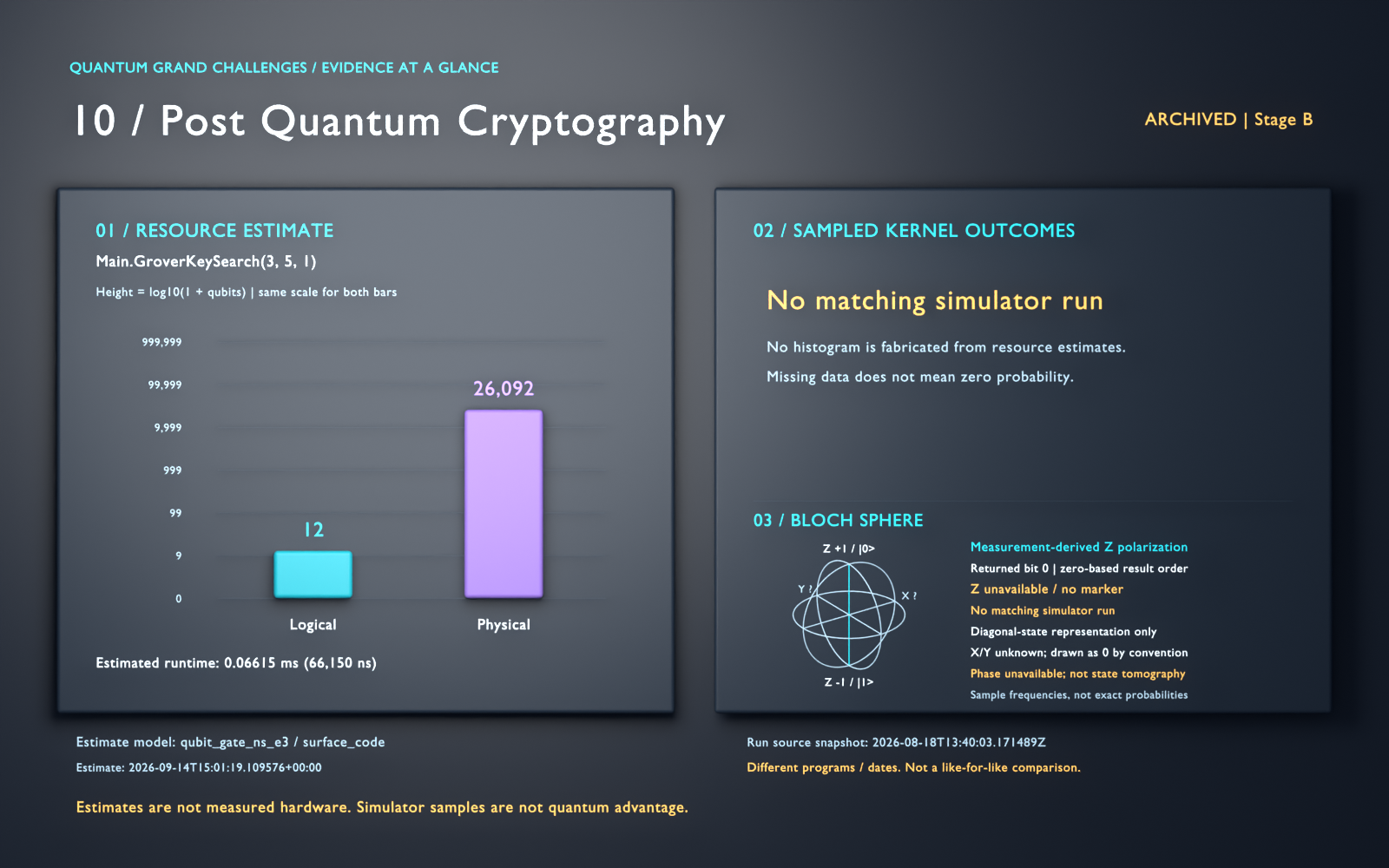
- Resource estimates and sampled kernel outcomes describe different programs. Neither demonstrates quantum advantage; this is not a quantum-state animation.
- No successful local-simulator histogram in the selected run source.
- Archived problem; not an active quantum-advantage candidate.
Resource Estimation (Azure Quantum RE)
Resource Breakdown
Calibration Evidence (20-Run Ensemble)
Stage D: Advantage Evidence Package
Grover's quadratic speedup is provably optimal but only halves the effective key length, and only if its iterations run in series. NIST expects Grover to give little or no advantage against AES and considers AES-128 secure for decades to come (NIST PQC FAQ). The practical threat to modern cryptography is from Shor (factoring) not Grover (search).
- Quadratic speedup only: it halves the effective key length and does not break modern cryptography
- Oracle implementation cost for real AES/SHA may be prohibitive (millions of T-gates)
- 33k physical qubits for 3-qubit toy instance; O(thousands of logical qubits) for AES-128
- Grover's speedup is already accounted for in NIST's post-quantum security categories, which are defined by the cost of AES key search
Noise Resilience (Depolarizing Simulation)
Ideal outcome: [One, Zero, One] (70% probability)
Cross-Platform Emulator Results (100 shots)
Troyer Utility-Scale Classification
Grover's quadratic speedup is provably optimal but only halves the effective key length, and only if its iterations run in series. NIST expects Grover to give little or no advantage against AES and considers AES-128 secure for decades to come (NIST PQC FAQ); NSA's CNSA 2.0, as CNSA 1.0 did, still requires AES-256 for US national security systems. The practical threat is from Shor, not Grover.
These two numbers describe different programs
The resource estimate below is for Main.GroverKeySearch(3, 5, 1), the algorithm at utility scale. The Azure Quantum runs executed GroverKeyKernel(), a small kernel sized to fit today's hardware. Qubit counts and runtimes from the estimate are not measurements of the run, and the run histogram is not a sample of the estimated circuit.
Pareto Frontier: Qubits vs Runtime
The estimator returns 4 viable configurations, not one answer. Every headline figure on this page comes from the leftmost point, which uses the fewest qubits and is therefore also the slowest. Buying 1.9x the qubits cuts runtime to 0.43x.
qubit_gate_ns_e3 with surface_code, error budget 1e-3. Points are Pareto-optimal: no other configuration is better on both axes.
Multi-Model Resource Comparison
Physical qubit requirements across 6 qubit technologies × 2 QEC schemes (inspired by Troyer Architecture Series, Part 3).
| Qubit Model | QEC | Physical Qubits | Logical Qubits |
|---|---|---|---|
| Superconducting (ns, 1e-4) | surface_code | 589 | 12 |
| Trapped Ion (μs, 1e-4) | surface_code | 589 | 12 |
| Superconducting (ns, 1e-3) | surface_code | 26,092 | 12 |
| Trapped Ion (μs, 1e-3) | surface_code | 26,092 | 12 |
Problem Documentation
Problem 10 · Post-Quantum Cryptography Security Analysis
Overview
Post-quantum cryptography (PQC) must withstand both classical and quantum attacks. Modern lattice schemes trade performance against resistance to advanced BKZ reduction and Grover-amplified sieving. This directory holds two pieces that answer different questions:
- **Classical script** (`python/classical_baseline.py`): a toy cost formula for BKZ lattice attacks on NIST-style parameter sets. Its quadratic cost in the block size and its Grover adjustment are illustrative; they are not the core-SVP estimates of the lattice estimator, so its margins are not security estimates.
- **Q# kernel** (`qsharp/src/Main.qs`): Grover search for one marked key among 2^n (3 to 5 qubits). With 3 qubits one iteration finds the key with probability 0.78125, checked against exact simulation. Its classical comparator is exhaustive search, (N + 1)/2 queries on average; it does not model sieving or a cipher.
Directory Layout
10_post_quantum_cryptography/
├── estimates/                      # JSON artifacts from classical / quantum workflows
├── instances/                      # Representative NIST parameter sets
├── plots/                          # Generated figures from analyze.py
├── python/
│   ├── classical_baseline.py       # Toy BKZ attack-cost formula
│   └── analyze.py                  # Visualization of security margins
└── qsharp/
    ├── qsharp.json                 # Modern QDK project file
    ├── src/Main.qs                 # Grover key search on 3-5 qubits
    └── HardwareKernel.qs           # QIR kernel for Azure Quantum
Quick Start
cd problems/archived/10_post_quantum_cryptography

# Toy attack-cost formula (writes estimates/classical_baseline.json)
python python/classical_baseline.py

# Visualize cost curves and margins
python python/analyze.py

# Grover key search demo
python -c "from qdk import qsharp; qsharp.init(project_root='qsharp'); qsharp.run('Main.RunPostQuantumAnalysis()', 1)"
Next Quantum Milestones
1. Amplitude Amplification Kernel – Prototype Grover-style boosts for nearest vector search cost models.
2. Hybrid BKZ Simulation – Integrate amplitude amplification with classical pruning heuristics in Q#.
3. Adaptive Parameter Study – Sweep lattice dimensions / modulus sizes to locate safe PQC parameters.
4. Resource Estimation – Quantify logical qubits and T-count for practical quantum sieving on targeted dimensions.
This scaffold keeps classical estimators reproducible while we prototype quantum-enhanced attack analyses. 🔐⚛️
Objective Maturity Gate
- **Current gate**: **Stage B complete** (classical baseline and Q# scaffold/build path are in place).
- **Next gate target**: **Stage C** (hardware-aware validation with uncertainty-bounded comparisons).
Stage C exit criteria for this problem:
- Execute at least one non-placeholder quantum workflow path tied to the problem objective.
- Report uncertainty-bounded comparisons between classical and quantum outputs on `small` and `medium` instances.
- Document transpilation/connectivity and backend assumptions used for reported quantum runs.
- Add calibration/noise-sensitivity evidence for the reported quantum metrics.
DiVincenzo Readiness (Stage C/D Overlay)
| Criterion | Status | Evidence / Notes |
|---|---|---|
| Scalable qubit system | partial | Problem-scoped instance baselines are in place; full hardware-scale projections are tracked as Stage C work. |
| Initialization | partial | Input/state initialization path is defined for current workflows, with backend-ready loading fidelity still to be hardened. |
| Coherence vs gate time | not-yet | Backend-calibrated coherence-vs-depth evidence is pending and required for Stage C/D promotion. |
| Universal gate set | partial | Q# scaffold/build path exists; gate-basis decomposition and transpilation evidence remain Stage C tasks. |
| Qubit-specific measurement | partial | Measurement outputs are defined for current validation flows; hardware readout characterization is pending. |
Advantage Claim Contract
- **Claim category (current)**: `projected`.
- **Problem class and regime**: Problem-specific challenge instances defined in this directory.
- **Fair baseline**: Exhaustive key search, (N + 1)/2 queries on average for one marked key among N. `python/classical_baseline.py` is a toy lattice-attack cost formula for a different question.
- **Quantum resource scaling claim**: Expected asymptotic advantage depends on algorithm family and implementation assumptions; no hardware-demonstrated speedup claim yet.
- **Data-loading and I/O assumptions**: Must be documented alongside future advantage claims.
- **Noise/error model assumptions**: Backend-specific model and calibration assumptions to be added at Stage C.
- **Confidence/uncertainty method**: To be reported using shot-based confidence intervals or equivalent statistical bounds.
- **Residual risks**: Oracle/state-preparation/transpilation overhead may dominate for near-term instance sizes.
Reproduce It
cd problems/10_post_quantum_cryptography
make classical        # Run classical baseline
make analyze          # Generate plots
make build            # Validate Q# compilation
make run              # Run Q# entry point
Key Files
qsharp/src/Main.qsQuantum algorithm implementationqsharp/HardwareKernel.qsAzure-submittable QIR kernelpython/classical_baseline.pyClassical reference implementationestimates/classical_baseline.jsonBaseline metrics