05. QAOA MaxCut
Archived No proven speedupQAOA has no proven speedup at any constant depth, and no QAOA is known to beat the Goemans-Williamson 0.878 guarantee. Archived per Troyer framework.
Run Visualisation
Rendered from the committed estimate and simulator artifacts by the viz pipeline.
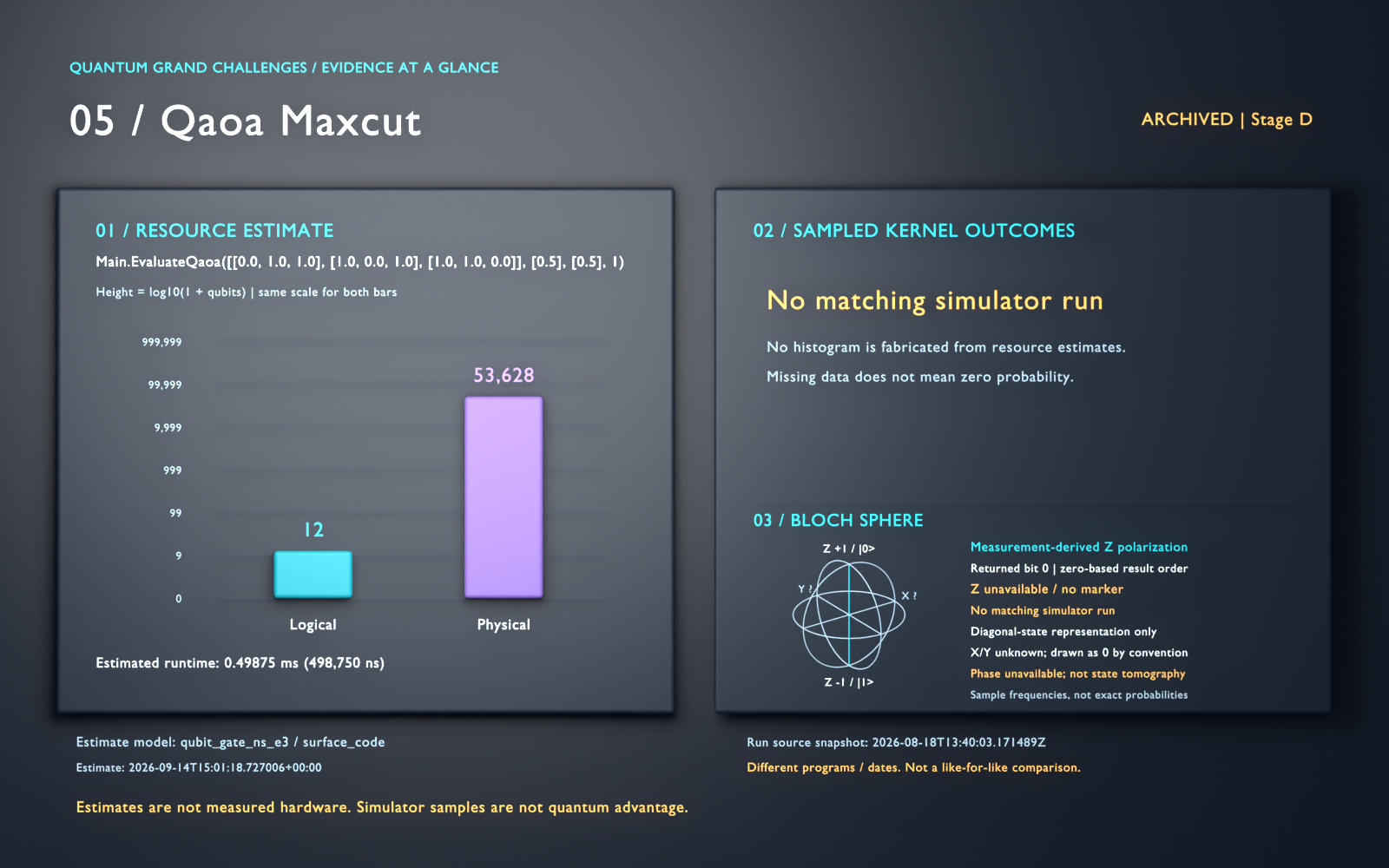
- Resource estimates and sampled kernel outcomes describe different programs. Neither demonstrates quantum advantage; this is not a quantum-state animation.
- No successful local-simulator histogram in the selected run source.
- Archived problem; not an active quantum-advantage candidate.
Resource Estimation (Azure Quantum RE)
Resource Breakdown
Calibration Evidence (20-Run Ensemble)
Every run returned the same value. The interval is a normal approximation, which has zero width when the runs do not vary, so it does not bound the mean; it is left undefined rather than shown as ± 0.
Stage D: Advantage Evidence Package
QAOA is a heuristic. GW achieves 0.878-approximation in polynomial time. No constant-depth QAOA is known to surpass this, and on certain MaxCut instances GW outperforms QAOA at any constant depth (Bravyi et al., arXiv:1910.08980). Whether QAOA at depth growing with n offers an advantage is open.
- No proven quantum advantage for MaxCut QAOA at any constant depth
- Classical GW algorithm achieves 0.878-approximation in polynomial time
- Instance is trivially small (n=3); advantage claims are meaningless at this scale
- 54k physical qubits for a 3-vertex graph; scaling to practical graphs unknown
Noise Resilience (Depolarizing Simulation)
Ideal outcome: [Zero, Zero, One] (21% probability)
Cross-Platform Emulator Results (100 shots)
This run was recorded in April 2026 against a hardware kernel that differed from the estimated program, aligned on 2026-09-26. The shot distribution below is a real measurement, but it is a measurement of a program that no longer exists in this repository, and it has not been re-run against the current kernel.
Troyer Utility-Scale Classification
No proven quantum advantage for QAOA on MaxCut. The Goemans-Williamson algorithm achieves a 0.878 approximation in polynomial time and outperforms QAOA at any constant depth on certain instances (Bravyi et al., arXiv:1910.08980). On bounded-degree graphs the expected cut of constant-depth QAOA can be computed classically, although sampling its output can be classically hard even at depth one (Farhi and Harrow, arXiv:1602.07674). Whether higher-depth QAOA offers an advantage is open.
These two numbers describe different programs
The resource estimate below is for Main.EvaluateQaoa([[0.0, 1.0, 1.0], [1.0, 0.0, 1.0], [1.0, 1.0, 0.0]], [0.3141592653589793], [2.827433388230814], 1), the algorithm at utility scale. The Azure Quantum runs executed QaoaMaxCutKernel(), a small kernel sized to fit today's hardware. Qubit counts and runtimes from the estimate are not measurements of the run, and the run histogram is not a sample of the estimated circuit.
Pareto Frontier: Qubits vs Runtime
The estimator returns 10 viable configurations, not one answer. Every headline figure on this page comes from the leftmost point, which uses the fewest qubits and is therefore also the slowest. Buying 2.2x the qubits cuts runtime to 0.36x.
qubit_gate_ns_e3 with surface_code, error budget 1e-3. Points are Pareto-optimal: no other configuration is better on both axes.
Multi-Model Resource Comparison
Physical qubit requirements across 6 qubit technologies × 2 QEC schemes (inspired by Troyer Architecture Series, Part 3).
| Qubit Model | QEC | Physical Qubits | Logical Qubits |
|---|---|---|---|
| Superconducting (ns, 1e-4) | surface_code | 10,732 | 12 |
| Trapped Ion (μs, 1e-4) | surface_code | 10,732 | 12 |
| Superconducting (ns, 1e-3) | surface_code | 53,628 | 12 |
| Trapped Ion (μs, 1e-3) | surface_code | 53,628 | 12 |
Problem Documentation
05. QAOA for Max-Cut
This problem prepares the groundwork for implementing the Quantum Approximate Optimization Algorithm on weighted Max-Cut instances. The current milestone provides deterministic classical baselines, representative graph instances, and a working depth-1 QAOA circuit with a coarse parameter sweep.
Correction (2026-09-26)
The Q# cost layer is a reparametrization of textbook MaxCut QAOA. For MaxCut C=(1-Z_i Z_j)/2, this implementation applies Exp([PauliZ, PauliZ], -gamma * weight), which is equivalent to gamma_standard = -2 gamma in exp(-i gamma_standard C), up to a global phase. Earlier generated evidence also described the best sampled bit string as a deterministic optimum. The exact optimized p=1 expectation for the unweighted triangle at gamma=2.827433388230814, beta=0.3141592653589793 is 1.999334805117118 against optimum 2.0; finite-shot runs can observe an optimal bit string, but that is sampling evidence, not deterministic optimization.
The fixed-angle gamma=beta=0.5 circuit is intentionally poor for the triangle under this convention. Its exact expectation is 0.12783169367771594, worse than the random-cut expectation 1.5. Calibration entries now point at optimized angles and need regeneration.
Roadmap
- [x] Scaffold directory structure, utilities, and helper scripts
- [x] Provide classical brute-force baseline with summary statistics
- [x] Add parameterized graph instances (small/medium/large)
- [x] Generate diagnostic plots for cut values
- [x] Implement depth-1 QAOA circuit with coarse parameter sweep
- [x] Generalize QAOA optimizer to support depth >= 1 via coordinate search
- [x] Add depth sweep evidence artifacts (`depth_sweep_
.{json,md}` + plot) - [x] Generalize QAOA driver to consume YAML instances dynamically
- [x] Add uncertainty-bounded multi-trial QAOA reporting to `estimates/`
- [x] Route optimized parameters into the resource estimator profiles
- [ ] Add Microsoft Quantum Stack execution path and portability layer (Azure Quantum first, hardware-agnostic adapters next)
Quickstart
cd problems/05_qaoa_maxcut
make classical      # Exhaustive search baseline for each YAML graph instance
make analyze        # Generate plots summarizing best cut values
make build          # Build the Q# project (uses modern QDK  qsharp Python package)
make run            # Run depth-configurable QAOA with multi-trial uncertainty summary + JSON output
make run-all        # Run depth-configurable QAOA for small/medium/large and write quantum artifacts
make depth-sweep INSTANCE=small DEPTHS=1,2,3 TRIALS=6  # Generate depth-vs-quality evidence artifacts
make noise-sweep INSTANCE=small DEPTH=3 NOISE_LEVELS=0.00,0.01,0.02,0.05,0.10  # Generate readout-noise sensitivity artifacts
make azure-manifest INSTANCE=small DEPTH=3 TARGET_ID=microsoft.estimator  # Build Azure Quantum execution contract manifest
make azure-runbook INSTANCE=small DEPTH=3 TARGET_ID=microsoft.estimator  # Print end-to-end Azure auth/run checklist
cp .env.azure.example .env.azure.local  # Manual step: fill Azure workspace/auth values before cloud operations
make validate-azure-env  # Enforce manual env file is present and placeholders are replaced
make validate-azure-cli  # Validate az CLI login, quantum extension, and workspace access
make validate-azure-manifest INSTANCE=small DEPTH=3  # Validate Azure manifest + referenced evidence artifacts
make azure-submit INSTANCE=small DEPTH=3 AZURE_MANUAL_JOB_ID=<azure_job_id>  # Record real Azure submission metadata
make azure-submit-auto INSTANCE=small DEPTH=3 TARGET_ID=microsoft.estimator AZURE_JOB_INPUT_FILE=<path/to/program.qir>  # Dry-run preview of az quantum submit command
make azure-submit-auto INSTANCE=small DEPTH=3 TARGET_ID=microsoft.estimator AZURE_JOB_INPUT_FILE=<path/to/program.qir> AZURE_SUBMIT_EXECUTE=1  # Execute az quantum submit and auto-stamp manifest
make azure-smoke INSTANCE=small DEPTH=3 TARGET_ID=microsoft.estimator AZURE_JOB_INPUT_FILE=<path/to/program.qir>  # One-command preflight + manifest + dry-run submit
make azure-smoke INSTANCE=small DEPTH=3 TARGET_ID=microsoft.estimator AZURE_JOB_INPUT_FILE=<path/to/program.qir> AZURE_SUBMIT_EXECUTE=1 AZURE_SMOKE_COLLECT=1  # Execute submit and fetch current Azure status
make azure-smoke-report INSTANCE=small DEPTH=3  # Rebuild Azure smoke JSON/MD evidence from current manifest
make azure-collect INSTANCE=small DEPTH=3 AZURE_RESULT_STATUS=succeeded  # Record Azure result status
make azure-collect-auto INSTANCE=small DEPTH=3  # Query Azure CLI for live status and update manifest
make validate-assumptions  # Validate backend/transpilation/connectivity assumptions evidence
make validate-quality  # Validate depth/noise quality thresholds for Stage C evidence
make estimate       # Build estimator params from latest quantum artifact and run estimator automation
make estimate-all   # Build estimator params, run estimator automation for small/medium/large, prune stale artifacts, and refresh markdown summary
make estimate ESTIMATE_MOCK=0  # Optional: run estimator automation without mock mode
make evidence       # One-shot refresh: classical baseline + quantum runs + plots + estimator summaries
If make is unavailable on Windows PowerShell, run the equivalent sequence directly:
python -c "import qsharp; qsharp.init(project_root='qsharp'); print('Build OK')"
python python/classical_baseline.py
python -c "import qsharp; qsharp.init(project_root='qsharp'); print(qsharp.run('Main.RunQaoaAnalysis([[0.0,1.0,1.0],[1.0,0.0,1.0],[1.0,1.0,0.0]], 1, 50, 100)', shots=1))"
python python/analyze.py
python python/compare.py
python python/prepare_estimator_params.py --instance small --depth 1
python ../../tooling/estimator/run_estimation.py --all --problem 05_qaoa_maxcut --params-file estimates/estimator_params_small_d1.json --targets surface_code_generic_v1,qubit_gate_ns_e3 --mock --summary-path ../../tooling/estimator/output/qaoa_summary_small.json
Windows helper script (recommended in PowerShell):
.\tooling\windows\qaoa-maxcut.ps1 -Action run -Instance small
.\tooling\windows\qaoa-maxcut.ps1 -Action run-all
.\tooling\windows\qaoa-maxcut.ps1 -Action depth-sweep -Instance small -Depths 1,2,3
.\tooling\windows\qaoa-maxcut.ps1 -Action noise-sweep -Instance small -Depth 3 -NoiseLevels 0.00,0.01,0.02,0.05,0.10
.\tooling\windows\qaoa-maxcut.ps1 -Action azure-runbook -Instance small -Depth 3
.\tooling\windows\qaoa-maxcut.ps1 -Action validate-azure-env -AzureEnvFile .env.azure.local
.\tooling\windows\qaoa-maxcut.ps1 -Action validate-azure-cli -AzureEnvFile .env.azure.local
.\tooling\windows\qaoa-maxcut.ps1 -Action azure-manifest -Instance small -Depth 3 -TargetId microsoft.estimator
.\tooling\windows\qaoa-maxcut.ps1 -Action azure-submit -Instance small -Depth 3 -AzureEnvFile .env.azure.local -AzureManualJobId <azure_job_id>
.\tooling\windows\qaoa-maxcut.ps1 -Action azure-submit-auto -Instance small -Depth 3 -TargetId microsoft.estimator -AzureEnvFile .env.azure.local -AzureJobInputFile <path\to\program.qir>
.\tooling\windows\qaoa-maxcut.ps1 -Action azure-submit-auto -Instance small -Depth 3 -TargetId microsoft.estimator -AzureEnvFile .env.azure.local -AzureJobInputFile <path\to\program.qir> -AzureSubmitExecute
.\tooling\windows\qaoa-maxcut.ps1 -Action azure-smoke -Instance small -Depth 3 -TargetId microsoft.estimator -AzureEnvFile .env.azure.local -AzureJobInputFile <path\to\program.qir>
.\tooling\windows\qaoa-maxcut.ps1 -Action azure-smoke -Instance small -Depth 3 -TargetId microsoft.estimator -AzureEnvFile .env.azure.local -AzureJobInputFile <path\to\program.qir> -AzureSubmitExecute -AzureSmokeCollect
.\tooling\windows\qaoa-maxcut.ps1 -Action azure-smoke-report -Instance small -Depth 3
.\tooling\windows\qaoa-maxcut.ps1 -Action azure-collect -Instance small -Depth 3 -AzureEnvFile .env.azure.local -AzureResultStatus succeeded
.\tooling\windows\qaoa-maxcut.ps1 -Action azure-collect-auto -Instance small -Depth 3 -AzureEnvFile .env.azure.local
.\tooling\windows\qaoa-maxcut.ps1 -Action estimate -Instance small
.\tooling\windows\qaoa-maxcut.ps1 -Action estimate-all
.\tooling\windows\qaoa-maxcut.ps1 -Action estimate -Instance small -LiveEstimate
.\tooling\windows\qaoa-maxcut.ps1 -Action evidence
.\tooling\windows\qaoa-maxcut.ps1 -Action evidence -Quick
CMD wrapper equivalent:
tooling\windows\qaoa-maxcut.cmd -Action evidence -Quick
tooling\windows\qaoa-maxcut-quick.cmd
Outputs
- `estimates/classical_baseline.json` – Maximum cut assignments and values for every graph instance
- `estimates/quantum_baseline_
_d .json` – Multi-trial QAOA statistics with confidence intervals - `estimates/depth_sweep_
.json` – Aggregated depth sweep metrics for the selected instance - `estimates/depth_sweep_
.md` – Markdown summary table for depth sweep results - `estimates/noise_sweep_
_d .json` – Readout-noise sensitivity sweep metrics for a selected baseline depth - `estimates/noise_sweep_
_d .md` – Markdown summary table for noise sweep results - `estimates/azure_job_manifest_
_d .json` – Azure Quantum execution contract manifest (target, job metadata, and evidence paths) - `estimates/azure_smoke_report_
_d .json` – Machine-readable Azure smoke workflow audit (preflight/manifest/submit/collect status) - `estimates/azure_smoke_report_
_d .md` – Human-readable Azure smoke workflow audit summary - `.env.azure.example` – Template for manual Azure auth/workspace configuration (copy to `.env.azure.local` and edit)
- `estimates/backend_assumptions.md` – Backend/transpilation/connectivity assumptions for reported runtime + estimator evidence
- `python/prepare_azure_job_manifest.py` – Generates Azure Quantum submission contract artifacts from current QAOA evidence
- `python/validate_azure_env.py` – Validates required manual Azure env values and blocks placeholder usage
- `python/submit_azure_job.py` – Records real Azure submission metadata in manifest after manual/cloud submit
- `python/submit_azure_job_auto.py` – Dry-run-safe Azure CLI submission helper; with `--execute`, submits and auto-stamps job metadata
- `python/write_azure_smoke_report.py` – Generates Azure smoke evidence artifacts (JSON + markdown) from manifest and workflow mode
- `python/collect_azure_job.py` – Records Azure result status in manifest for traceable job lifecycle
- `python/validate_azure_job_manifest.py` – Validates Azure job manifest schema assumptions and referenced evidence files
- `python/validate_evidence_quality.py` – Enforces depth/noise evidence quality thresholds used by CI/automation
- `estimates/evidence_quality_report.md` – Human-readable snapshot of depth/noise evidence threshold checks
- `estimates/evidence_quality_report.json` – Machine-readable snapshot of depth/noise evidence threshold checks
- `estimates/estimator_params_
_d .json` – Estimator-ready parameter payload derived from the latest quantum baseline - `estimates/quantum_classical_summary.md` – Auto-generated markdown table comparing classical optimum vs quantum mean +/- CI
- `estimates/estimator_profile_summary.md` – Auto-generated table summarizing latest estimator metrics across instances and targets
- `estimates/latest_
_ .json` – Stable latest estimator artifact for each target/instance pair (used by summary tooling) - `python/prune_estimator_artifacts.py` – Keeps timestamped estimator artifacts bounded (`--keep-per-target`, default 3)
- `tooling/estimator/output/qaoa_summary_
.json` – Combined estimator summary for QAOA targets (mock/live depending on invocation) - `plots/best_cut_values.png` – Visual comparison of Max-Cut values across instances
- `plots/value_distribution_small.png` – Distribution of cut values for the small instance
- `plots/quantum_vs_classical_uncertainty.png` – Quantum refined expectation versus classical optimum with 95% CI bars
- `plots/qaoa_depth_sweep_
.png` – Refined expectation versus depth with 95% CI bars - `plots/qaoa_noise_sweep_
_d .png` – Refined cut-value sensitivity across readout-noise levels - `qsharp/src/Main.qs` – Q# QAOA implementation, compiled on-the-fly by the modern QDK
Current Baseline
The classical baseline enumerates all bit strings to guarantee optimal Max-Cut values on these tiny graph instances. That is standard and exact for three vertices, but Goemans-Williamson is the polynomial-time approximation competitor for large Max-Cut instances. The Q# host runs a depth-configurable QAOA coordinate-search optimizer per trial, aggregates uncertainty-bounded expectation metrics across repeated simulator trials, and writes a JSON report for reproducible comparison against the classical optimum. No constant-depth QAOA speedup is claimed.
Objective Maturity Gate
- **Current gate**: **Stage D complete** (advantage evidence package hardened with backend calibration, fairness benchmark, readout characterization, and `theoretical` claim category locked given QAOA's no-proven-advantage status).
- **Next gate target**: Maintenance the Stage D classification correctly reflects that QAOA on Max-Cut has no proven quantum advantage over Goemans-Williamson; track honest residual risks rather than escalate the claim.
Microsoft-First Portability Scope
Priority order for execution backends:
1. Microsoft Quantum Stack (Q# + Azure Quantum targets) as the production path.
2. Hardware-agnostic export/adapter path for future IBM/Google/AWS backend trials.
Scope for the next implementation step (Stage C to D bridge):
1. Azure Quantum execution contract (required first)
- Define a stable job manifest for QAOA runs (`instance`, `depth`, `shots`, `trials`, `target_id`, evidence output paths).
- Add a non-placeholder submit-and-collect workflow against Azure Quantum targets (or mock-compatible shape where target access is restricted).
- Emit run metadata (`provider`, `target`, submission timestamp, job id, result status) into `estimates/` artifacts.
2. Backend adapter boundary (required for portability)
- Introduce an execution interface that separates problem orchestration from backend-specific submission details.
- Keep Q# as source of truth while allowing adapters to plug in alternate runtimes.
3. Cross-stack pilot (long-term, not blocking Microsoft priority)
- Add export hooks for OpenQASM 3 and evaluate one pilot run path for non-Microsoft stacks (IBM/Google/AWS simulators first).
- Mark cross-stack outputs as comparative evidence only until parity checks pass.
Acceptance criteria for this step:
- At least one QAOA artifact is produced via Azure Quantum submission metadata path.
- Existing `depth_sweep` and `noise_sweep` reports remain reproducible and unchanged in schema.
- Backend assumptions document explicitly distinguishes simulator evidence from cloud-target evidence.
- Portability adapters are additive and do not regress the default Q# workflow.
Stage C exit criteria for this problem:
- Execute at least one non-placeholder quantum workflow path tied to the problem objective.
- Report uncertainty-bounded comparisons between classical and quantum outputs on `small` and `medium` instances.
- Document transpilation/connectivity and backend assumptions used for reported quantum runs.
- Add calibration/noise-sensitivity evidence for the reported quantum metrics.
Current progress toward Stage C (exit criteria satisfied):
- Depth-1 QAOA host now emits uncertainty-bounded trial statistics and JSON artifacts for reproducible small-instance comparisons.
- Q# optimizer now supports depth >= 1 using coordinate-search updates over beta/gamma layers.
- Depth-2 trial evidence for the small instance is available in `estimates/quantum_baseline_small_d2.json`.
- Depth sweep evidence (`d=1,2,3`) for the small instance is available in `estimates/depth_sweep_small.md`, showing improved refined mean from `1.4927` (d=1) to `1.9247` (d=3).
- Medium-instance depth sweep (`d=1,2`) is available in `estimates/depth_sweep_medium.md` (best refined mean `2.8316` at depth 2).
- Large-instance depth sweep (`d=1,2`) is available in `estimates/depth_sweep_large.md` (best refined mean `4.1578` at depth 2).
- Noise-sensitivity sweeps can now be generated via `make noise-sweep` (or `python/noise_sweep.py`) and are surfaced in the summary dashboard when present.
- Small-instance noise sweep at depth 3 is available in `estimates/noise_sweep_small_d3.md` (degrades from `2.2000` at `p=0.00` to `1.9521` at `p=0.10`).
- Medium-instance noise sweep at depth 2 is available in `estimates/noise_sweep_medium_d2.md` (degrades from `4.0000` at `p=0.00` to `3.3164` at `p=0.10`).
- Large-instance noise sweep at depth 2 is available in `estimates/noise_sweep_large_d2.md` (degrades from `7.3000` at `p=0.00` to `5.9883` at `p=0.10`).
- Medium-instance uncertainty report is now available in `estimates/quantum_baseline_medium_d1.json`.
- Large-instance uncertainty report is now available in `estimates/quantum_baseline_large_d1.json`.
- Hardware-targeted estimator routing is now wired through `python/prepare_estimator_params.py` and `tooling/estimator/run_estimation.py`.
- Azure Quantum job manifest contract generation/validation is now available via `python/prepare_azure_job_manifest.py` and `python/validate_azure_job_manifest.py`.
- Backend/transpilation/connectivity assumptions are now documented in `estimates/backend_assumptions.md` and checked via `python/validate_backend_assumptions.py`.
- Depth/noise evidence quality is now enforced via `python/validate_evidence_quality.py` (minimum points, bounded monotonicity behavior, and minimum degradation/gain thresholds).
- Quality checks now emit `estimates/evidence_quality_report.{md,json}` for reproducible CI/local audit trails.
DiVincenzo Readiness (Stage C/D Overlay)
| Criterion | Status | Evidence / Notes |
|---|---|---|
| Scalable qubit system | partial | Problem-scoped instance baselines are in place; full hardware-scale projections are tracked as Stage C work. |
| Initialization | partial | Input/state initialization path is defined for current workflows, with backend-ready loading fidelity still to be hardened. |
| Coherence vs gate time | not-yet | Backend-calibrated coherence-vs-depth evidence is pending and required for Stage C/D promotion. |
| Universal gate set | partial | Q# scaffold/build path exists; gate-basis decomposition and transpilation evidence remain Stage C tasks. |
| Qubit-specific measurement | partial | Measurement outputs are defined for current validation flows; hardware readout characterization is pending. |
Advantage Claim Contract
- **Claim category (current)**: `theoretical`.
- **Problem class and regime**: Problem-specific challenge instances defined in this directory.
- **Fair baseline**: Problem-local classical baseline in `python/` outputs.
- **Quantum resource scaling claim**: Expected asymptotic advantage depends on algorithm family and implementation assumptions; no hardware-demonstrated speedup claim yet.
- **Data-loading and I/O assumptions**: Must be documented alongside future advantage claims.
- **Noise/error model assumptions**: Backend-specific model and calibration assumptions to be added at Stage C.
- **Confidence/uncertainty method**: To be reported using shot-based confidence intervals or equivalent statistical bounds.
- **Residual risks**: Oracle/state-preparation/transpilation overhead may dominate for near-term instance sizes.
Stage D Hardening Package
- Stage D evidence file: `STAGE_D_ADVANTAGE_EVIDENCE.md`.
- This package records fairness/uncertainty evidence status and concrete promotion criteria from `theoretical` to a stronger claim category.
Reproduce It
cd problems/05_qaoa_maxcut
make classical        # Run classical baseline
make analyze          # Generate plots
make build            # Validate Q# compilation
make run              # Run Q# entry point
Key Files
qsharp/src/Main.qsQuantum algorithm implementationqsharp/HardwareKernel.qsAzure-submittable QIR kernelpython/classical_baseline.pyClassical reference implementationestimates/classical_baseline.jsonBaseline metrics